
LOSING CONTROL
TOO MANY BUTTONS!

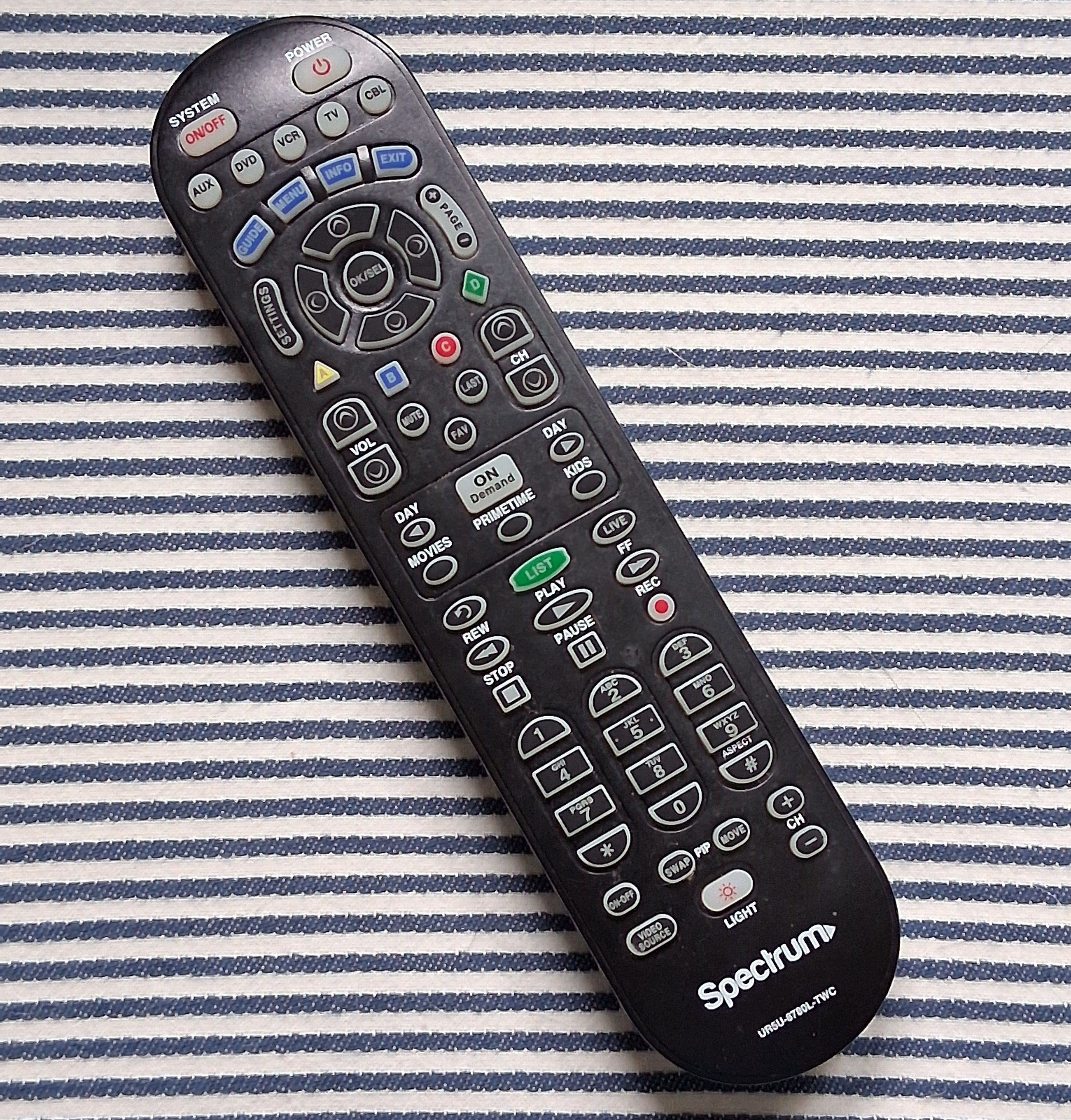
Remember that iconic line in the movie “Amadeus” when the young Mozart plays a highly-ornamented piano piece for his patron, and one of the Emperor’s ministers declares, “Too many notes!” The minister then goes on to expand on his understanding of musical theory—and physiology—opining that the human ear is capable of hearing only so many notes. Or, in other words, the human brain can process only a finite amount of data. Well, I’m afraid that I may personally have hit that data ceiling with digital technology: too many buttons!
Take the ubiquitous living room TV “clicker”, that hand-held remote device which programs and controls our television sets. The main clicker in our front room (there is also a second remote for the auxiliary “Roku” box) has no less than sixty buttons! Fortunately, my wife—with her tenacity and engineering brain—was able to hook up our household wireless system. But one night after watching a movie alone on our new smart TV, I discovered that I couldn’t turn it off with the clicker. And that there were no control buttons on the TV itself. Finally in exasperation, I pulled the power plug. All of those damned buttons, and not one of them would simply turn off the TV!
But this is a larger issue than just some cranky old Luddite who hates his TV clicker. This strikes at the heart of our innate need to understand and control our daily lives. Our need for personal agency. The mid-20th Century world I grew up in was still organized around mechanical principles dating back to antiquity: the fulcrum and lever; the inclined plane; the wheel and axle; etc. If a machine stopped working, you isolated the defective part in the operational sequence and repaired or replaced it. A person of average intelligence could visually identify the problem and fix it with simple hand tools. Not so today.
What we are being robbed of in this digital world is hands-on control and a feeling of personal competence in our lives. When something breaks, nobody even thinks to fix it any more. You throw it away, or call a repairman. Of course there is obviously a commercial incentive for manufacturers to make their designs and their products so complicated that consumers can’t repair them—they are just trying to keep their own people working. I get that. But this process of designed obfuscation has gone on for so long now that no one any longer even has tools, much less tool skills. We lack both competence and confidence to fix things anymore. We have been diminished by all of this technology.
To be sure, there is much to admire in the brilliant science and engineering that have ushered us into the digital age. But consumers have paid a huge price in the loss of control. There are still mechanical parts in everything from cars to kitchen appliances; but the controls are all electronic and operated by an onboard computer. You don’t diagnose problems by looking at a mechanical sequence anymore—you read an error code from the computer screen. Next, you will probably need to refer to a manual or seek online support, and then execute a complex series of keystroke commands to reprogram the control device. (And then, there is always the question of whether or not the malfunction is in the working part, a control module, or in the computer itself!)
Of course good arguments can be made for the gains in speed and efficiency that have come out of the computer age. For instance, in automotive design and engineering, we have achieved better fuel economy, improved safety features, and lowered air pollution. But, at some point on this design continuum, it begs the question of whether or not the cost in consumer use and control is worth those gains. It is certainly amazing engineering that there is a device that can measure the air pressure in all four of your tires and transmit that data to your dashboard instrument cluster—but is it worth the aggravation of having to swing by your local car dealership to pump in a couple more pounds of air and get the light turned off? Admittedly, a negligible gain. And don’t even get me started on the multiplicity of vague problems that might be behind that very alarming “Check Engine” light. . .
Digital technology has also robbed us of our sense of location. The old constructs of relative position on a document, a map, or even on the surface of the earth have all been altered in this digital age. The visual memory we might have of where a particular phrase is located in a printed document, for instance, is totally scrambled on a screen. If you open the document on your laptop, it might be in the lower left-hand corner of screen one; but if you open it on your smartphone, that same phrase might be in a totally different location on page two. Digital documents on a screen are totally fluid: touch the font or text size buttons, and the words assume totally new positions in the visual field. Data no longer stays in a fixed location like it does on a hard copy document.
And the old conventions of locating yourself on a printed map—North at the top, South at the bottom, East to the right, and West to the left—have all but disappeared and been supplanted by GPS. (Next time you are talking to a twenty-five-year old, ask them to point to North for you to see if they can.) I used to have pretty good dead reckoning skills and a sense of direction; but after ten years with GPS on a smartphone, even I feel those skills waning.
And what the heck! GPS is a whole lot more accurate tool, so why would you not use it? Right? I guess so. As long as there is a reliable power source and those communication satellites stay up there. But there is an undercurrent of vulnerability that I find disquieting. The modern world has so totally embraced digital technology that everything is controlled by computers—and computers can malfunction or be hacked. Labyrinthine computer networks control our financial systems, defense systems, and utility systems. If these big networks were to fail for some reason or be shut down in a cyber-attack, our modern world would be paralyzed. Scary stuff.
But in the wake of an infrastructure failure event, at least I wouldn’t have to worry any more about all of those damned buttons on my TV clicker, would I? Because with no power on the grid, nothing would be getting transmitted anyway, right? I guess I should be careful about what I wish for. . .
04/19/2020